human-in-the-loop AI agents for JD Edwards · your credentials and data stay in your perimeter · learn more →
AI Agents for Oracle JD Edwards EnterpriseOne

The agent workforce for JD Edwards.

If a person can do it in JD Edwards, an agent can automate it — any application, any batch process, any module. And because work doesn't stop at the ERP's edge, agents also handle the steps around it: email, approvals, reconciliations, documents, and reporting.

agenticerp — ap-3way-match-runner
Built on
E1 web client + AIS REST
Works across
Every module · any UBE
Output
Standard JDE documents
Deployment
Managed cloud or your perimeter
see it run

Two real JD Edwards workflows — run end to end by agents

No human at the keyboard: a full EnterpriseOne year-end batch run, and a JDE Orchestration built on demand to answer a customer’s report request.

demo 1 · batch run

A real JDE batch, end to end

A real EnterpriseOne year-end run: batch jobs submitted and monitored, output parsed, and supplier-ready forms generated and delivered.

demo 2 · orchestration on demand

An “AP Aged” report, on demand

A customer asks for an A/P aged report; an agent builds the JD Edwards Orchestration on the fly to deliver it — no developer in the loop.

Want to see it on your workflow? Book a working session.

coverage

Every module. Every step. Beyond the ERP.

Agents operate JD Edwards the way your users do — through E1 applications and batch jobs — so there's no workflow they can't reach. And they keep working where the ERP stops.

💰

Financials

  • AP vouchers & payments
  • AR cash application
  • G/L journals & allocations
  • Account reconciliation
  • Fixed assets & job cost
🚚

Distribution

  • Sales order entry & release
  • Procurement & PO lifecycle
  • Receipts & voucher match
  • Inventory transactions
  • Advanced pricing checks
🏭

Manufacturing & more

  • Work order processing
  • Shop floor transactions
  • Address Book maintenance
  • UBE submission & monitoring
  • Period & year-end closes
🌐

Beyond the ERP

  • Email intake & escalations
  • Bank & supplier portals
  • Excel / PDF deliverables
  • Slack & Teams notifications
  • Scheduled, unattended runs

If it has a screen, an API, or a batch job — an agent can run it. The same framework that clears an AP inbox can release backorders, chase open POs, or close a period. Full breakdown: what can be automated in JD Edwards.

solutions

Four solutions already in production

AP vouchers, AP reconciliation, year-end 1099s, and an Orchestration Developer — built first because they're high-volume and painful. They're examples of the pattern, not the limits of it.

🧾

AP Vouchers & 3-Way Match

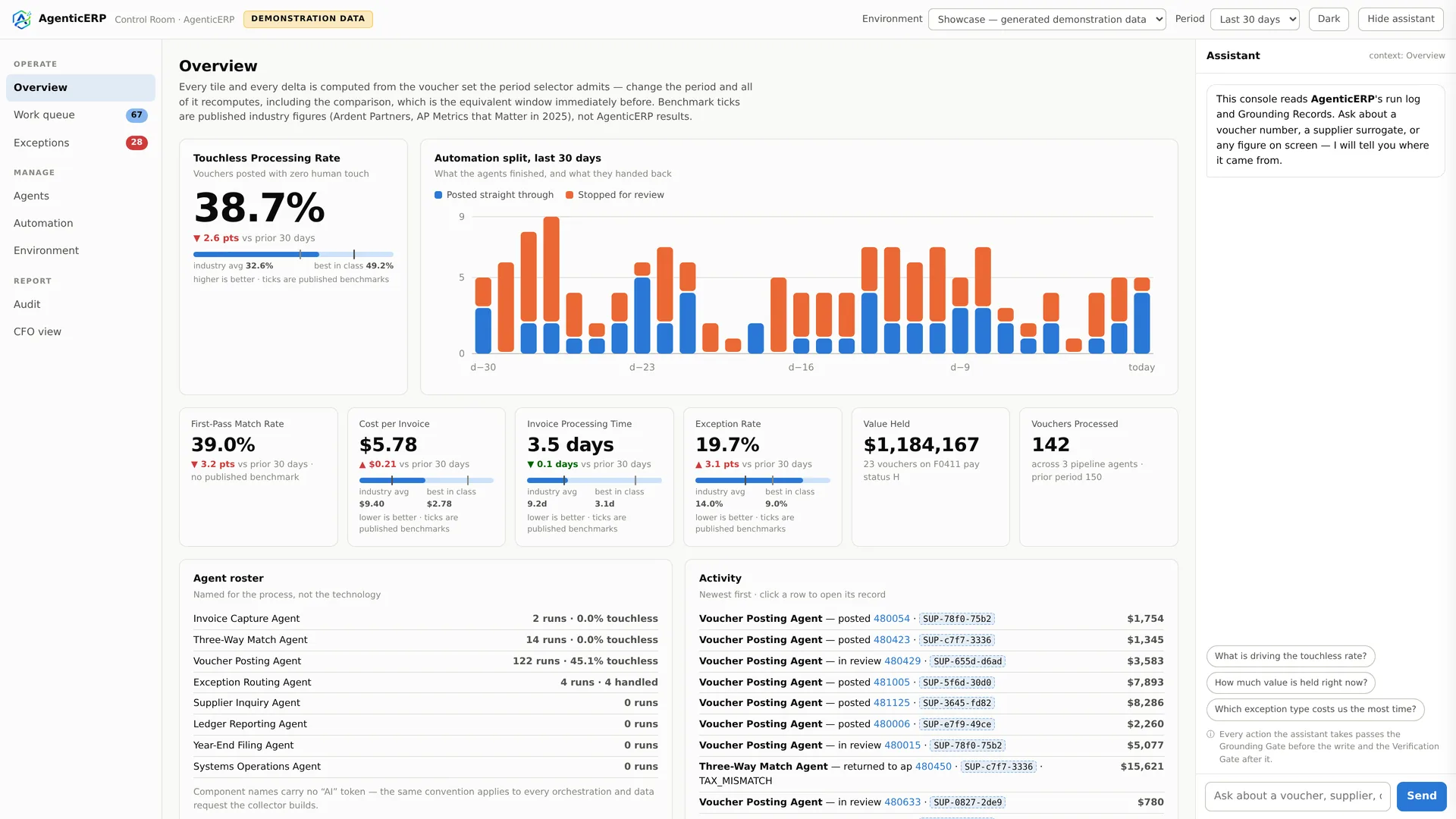
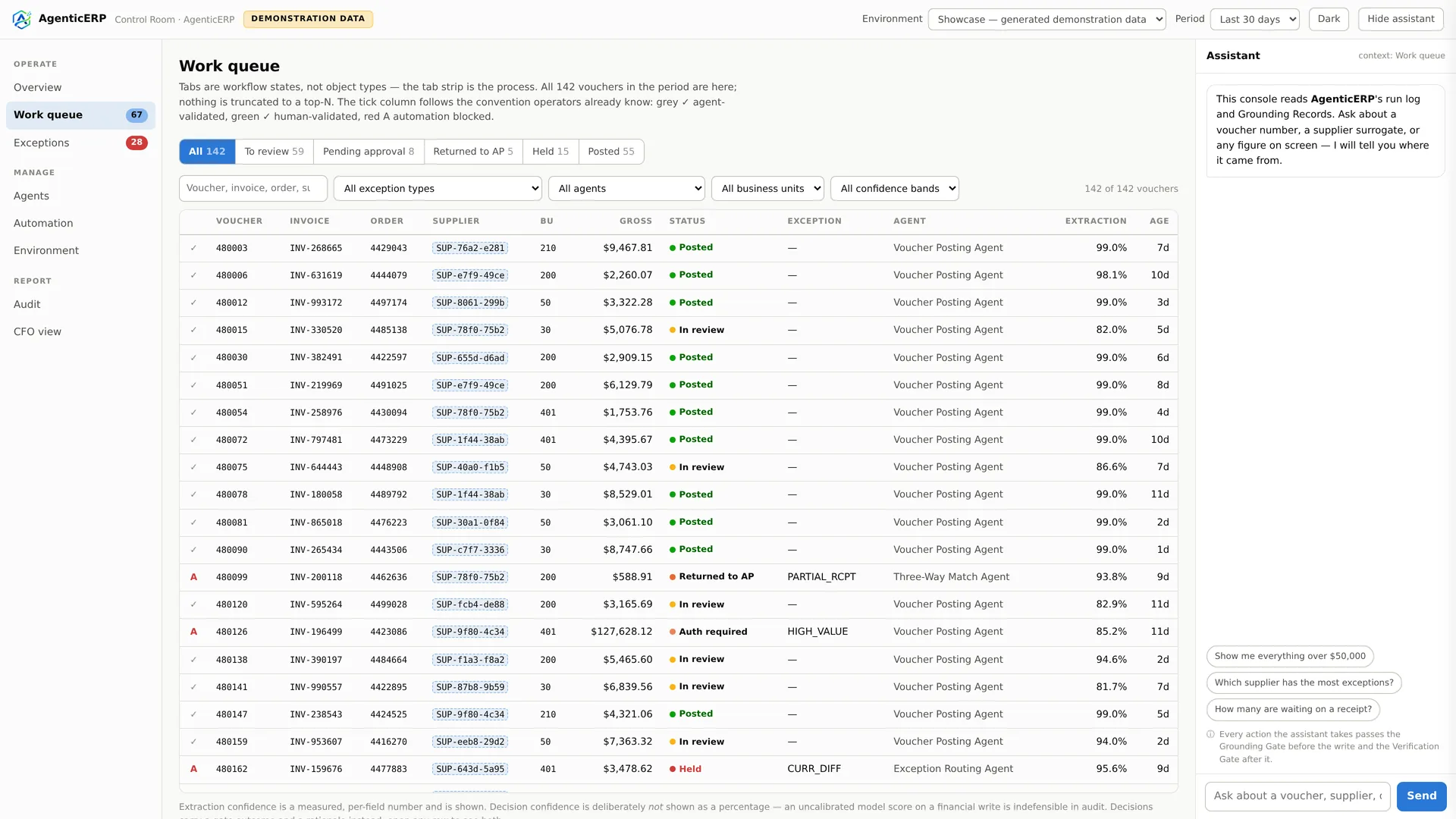
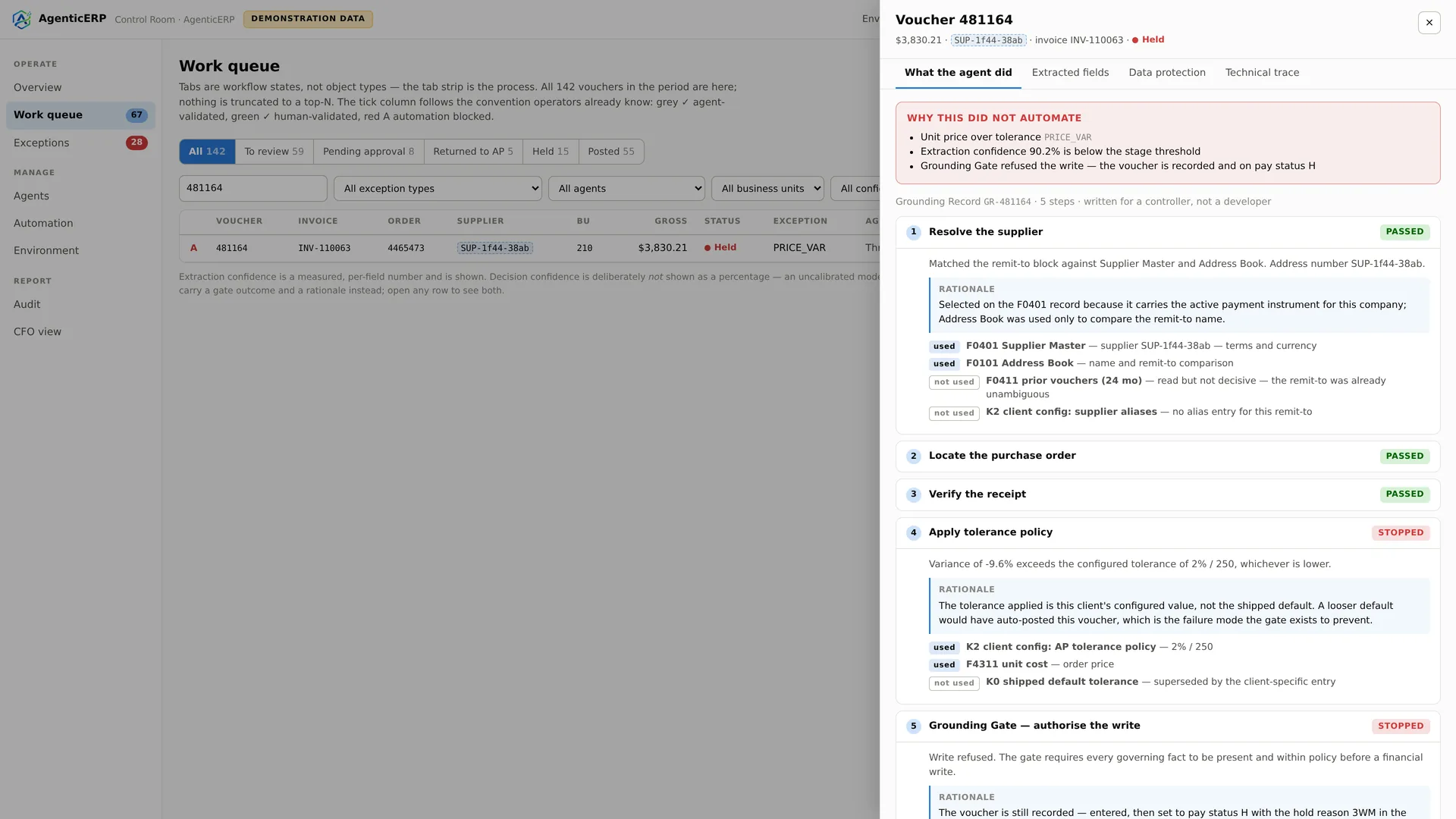
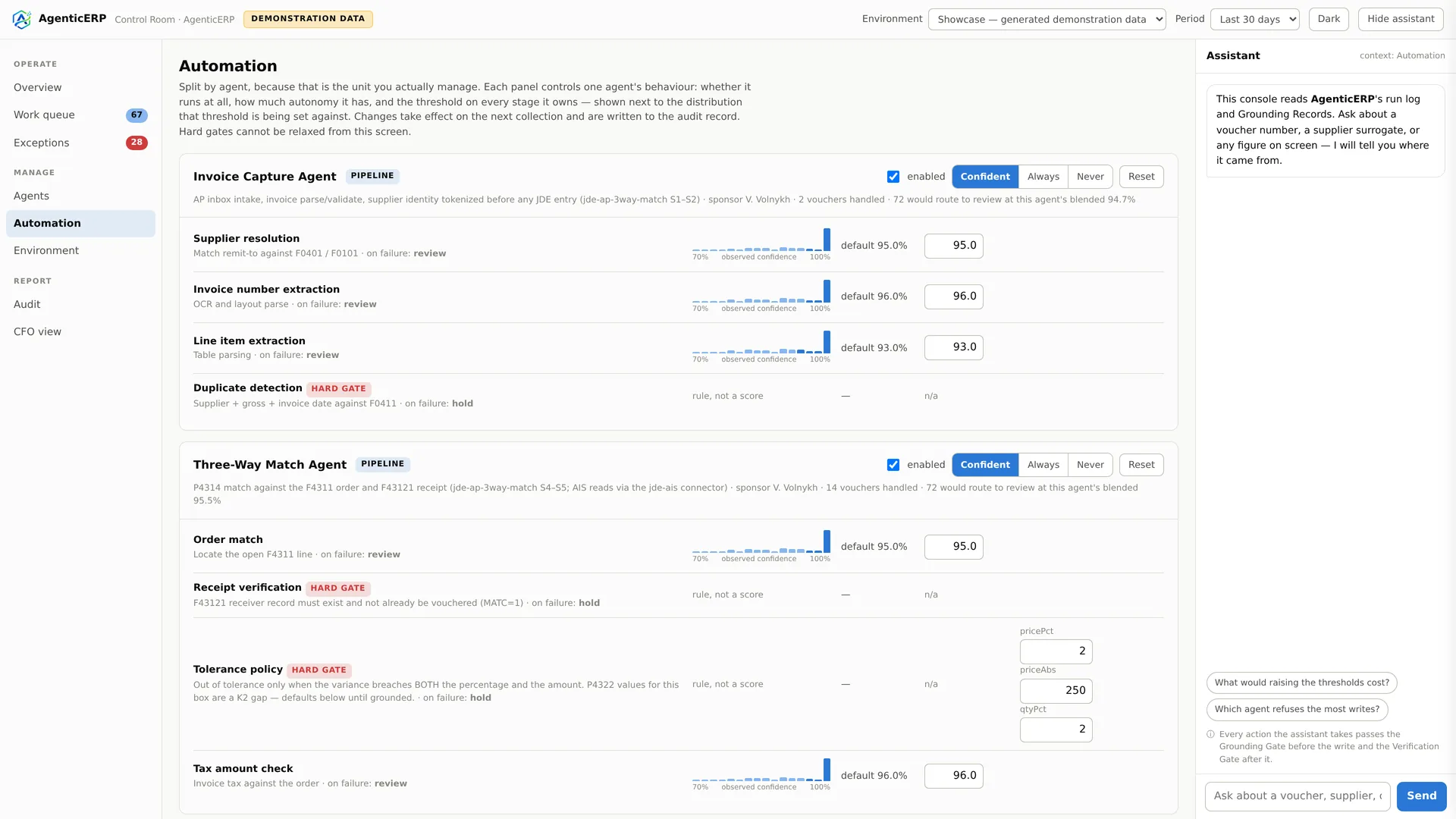
Reads the AP inbox, parses supplier invoices, verifies posted receipts, runs voucher match in P4314 against tolerance, and posts clean vouchers. Exceptions are held with Pay Status H and escalated to your AP Manager by email — the agent executes whichever resolution they pick.

P4314P43214P0411F43121AAI 4320
In production — see the pipeline ↓
🔁

AP Reconciliation

Ties out open AP against the G/L and payment activity: pulls F0411 vouchers and F0414 payments, compares them to the trade-payables accounts in F0911, isolates out-of-balance items by document and supplier, and delivers a reconciliation workpaper with every variance explained or flagged for review.

F0411F0414F0911AAI PCXLSX
Live example
📅

1099 Year-End Processing

Runs the full A/P Ledger Method year-end sequence — builds the workfile (R04514FP), writes 1099 media (P04515 → R045151), monitors job queues, pulls the facsimile PDF, then generates one IRS-compliant 1099 form per supplier and emails the batch. A week of January closes in one run.

R04514FPR045151P045151099-MISCGmail
In production — see the pipeline ↓
⚙️

Orchestration Developer

Have Orchestrations — or want to start building them? You don't need to hire a developer. The agent designs, builds, tests, reviews, and documents any orchestration you need, delivered as importable Studio components.

Orchestrator StudioAIS RESTRulesX-Refs
In production — see the product ↓
📨

Approvals & Audit Trail

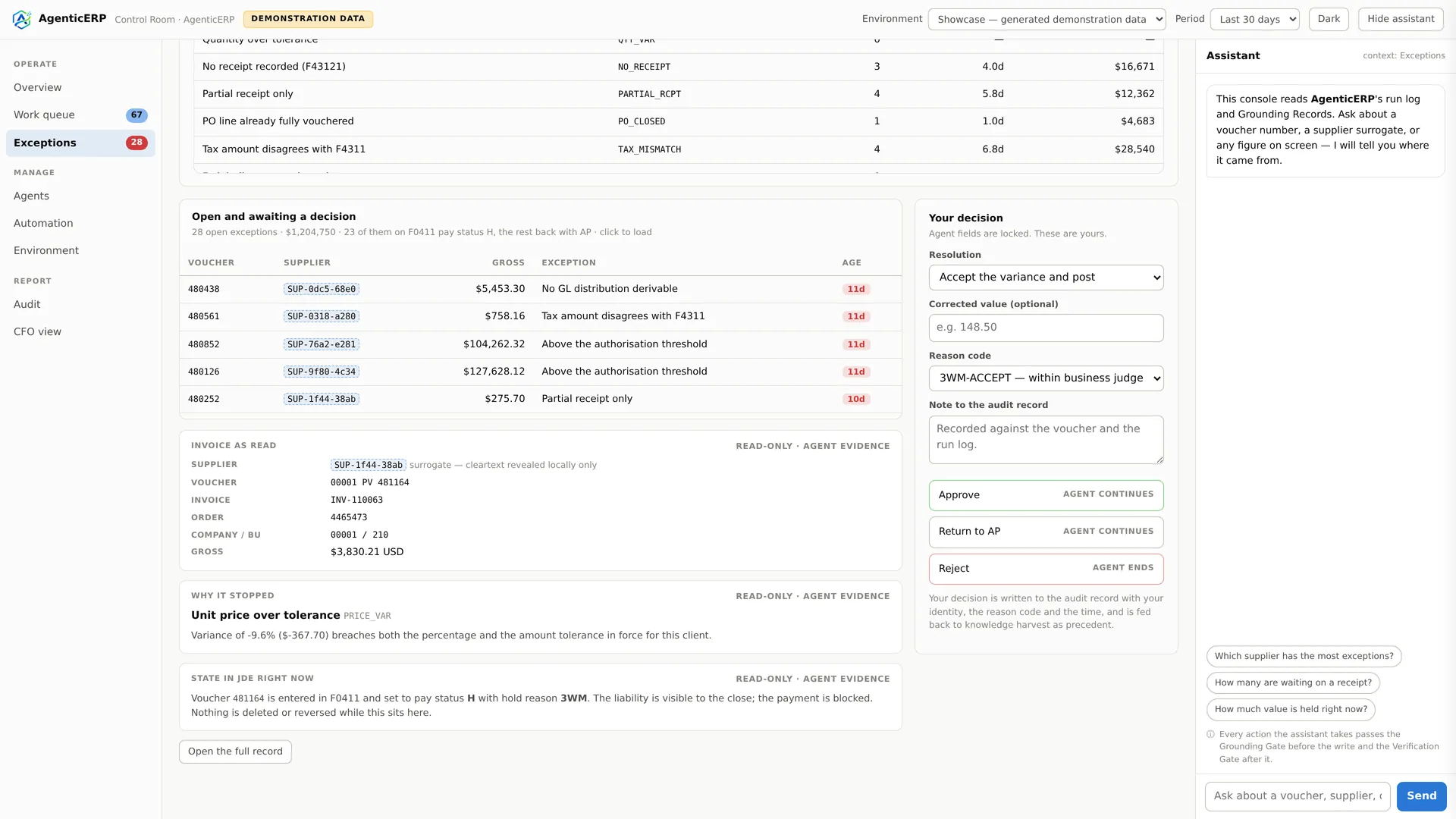
Anything requiring judgment goes to a human: structured email with the exact discrepancy and numbered resolution options — the agent executes the reply. Every run closes with a PDF + Excel report tying each action to JDE document keys and who authorized it.

Human-in-loopRun reportAudit trail
Platform capability
🧭

Your workflow next

Sales order release, backorder clearing, item master updates, supplier onboarding, period close checklists — any process your team runs in E1 can be decomposed into skills and handed to an agent. Pick the workflow that hurts most.

P4210P01012R09801Any module
Built to order
01 — automate

AP Agent. Invoice to posted voucher — no rekeying.

The agent clears your AP inbox the way your best analyst does: validates before it keys, matches against your own tolerances, posts what's clean, and brings a human only the decisions that need one.

Status
In production
Programs
P4314 · P43214 · P0411
Human gate
Exceptions only
Output
Posted vouchers + audit report
📥 AP Inbox Supplier invoices Email · PDF intake Parse + Validate JDE field mapping Duplicate checks Receipt Verify P43214 · F43121 MATC = 1 3-Way / 2-Way Match P4314 · qty / price / ext vs P4322 tolerances Your tolerance rules ✓ PASS ✓ Voucher posted F0411 · AAI 4320 relieved Posted, not on hold EXCEPTION ⏸ Held · Pay Status H Classified E1–E8 Recorded, unpayable 👤 AP Manager Exact discrepancy + options Replies with a number executes fix → re-match 📊 Run report Matched · held · resolved PDF + XLSX · JDE keys 8 nodes · closed loop · audited

Clean matches post without a human touch. Exceptions wait on a human decision — never on a guess. In production today; start with a pilot on your own invoices.

02 — close

Year-End Agent. A January of work, run in an afternoon.

The full A/P Ledger Method sequence, end to end: batch jobs submitted and monitored in E1, the facsimile parsed, one IRS-compliant form per supplier generated and delivered — with a complete audit trail.

Status
In production
Jobs
R04514FP · P04515 · R045151
Forms
One per supplier · IRS template
Delivery
Email batch + run summary
📅 Trigger Year-end run Scheduled, unattended UBE R04514FP Build 1099 A/P workfile Version XJDE0001 E1 P04515 · Write Media Write 1099 Media form Submits R045151 UBE Monitor R045151 Job queue polled to Done Facsimile PDF saved Parse + Validate Payer · payee · box amounts Flagged records logged 🧾 1099 Forms One per supplier IRS f1099 template email ✉ Email + run summary Links to every form Audit summary written Same pattern: AP reconciliation · period close · report delivery. 7 nodes · unattended · audited

Watch this exact run in the demo video — submitted, monitored, parsed, and delivered with no human at the keyboard.

03 — connect

Integration Agent. Two systems, one agent — exceptions managed.

The agent has access to both systems and moves data between them automatically — mapping, validating, and de-duplicating before anything touches E1. Exceptions become held records, and the agent runs the email workflow with your administrator until the issue is resolved.

Status
Built to order
Access
Both systems, both ways
Exceptions
Held + email workflow
Output
Sync report · JDE keys
🔗 External system CRM · EDI · 3PL · bank portal API · files · portal export JD Edwards E1 AIS REST · E1 web client F-tables · UBE · BSFN AI Integration Agent Reads both systems, both ways Maps · validates · de-duplicates Zero middleware ✓ reads & writes AIS · screens Create record in JDE Order · voucher · item · address Standard documents only POSTED ✓ Record created Posted · confirmed both sides Sync log updated EXCEPTION ⏸ Held record Status H · not processed Error captured in full 👤 Admin email workflow Exact error + numbered options Reminders until resolved runs until closed re-run after fix 📊 Sync report Every transfer · JDE keys Who resolved what 2 systems · 1 agent · exceptions managed

No middleware to license, no mappings to maintain by hand. The agent watches both ends, and an unresolved exception is never silent — it stays on the administrator's desk until it's closed.

04 — build

Orchestration Developer Agent. Any orchestration, no developer needed.

If you already have Orchestrations — or want to start building them — you don't need to hire a developer. The Orchestration Developer AI Agent creates any orchestration you need: it designs it, builds it, tests it against your environment, reviews it against best practices, and documents it — ready to import into your Orchestrator Studio.

Status
In production
Tooling
Orchestrator Studio · AIS REST
Cycle
Design → build → test → review → document
Output
Importable components + runbook + REST samples
📐

Design & build

Orchestrations and every component they need: form requests, data requests, business-function calls, connectors, custom scripts, rules, cross references, white lists, and schedules.

🧪

Test & debug

Runs each orchestration through the AIS REST layer, exercises edge cases, investigates failures, and verifies the side effects in the actual JDE tables — not just the response payload.

🔍

Best-practice review

Audits naming, input validation, error handling, security, and performance before anything is called production-ready — the review your busiest consultant never has time for.

📦

Document & deploy

Generates the runbook, REST invocation samples, and export packages for sharing — so the orchestration outlives whoever requested it.

A backlog of orchestration ideas and no one to build them? Hand it to the agent — it pairs naturally with Approach 2, where pre-built orchestrations are the controlled surface.

how it works

Agents that work the way your power users do

No middleware rip-and-replace. Agents operate JD Edwards through the same web client your team uses — or through AIS when an API path exists. Below: the AP voucher pipeline as a worked example.

1

Intake

The agent watches the AP inbox, pulls supplier invoices, and parses them into validated, JDE-mapped records — with duplicate checks before anything touches E1.

2

Execute in JDE

It signs into the E1 web client, verifies receipts in P43214, and runs voucher match in P4314 — evaluating quantity, price, and extended-amount variances against your tolerances.

3

Decide or escalate

Clean matches post automatically. Exceptions are classified (E1–E8), held on payment hold, and escalated to a human with concrete resolution options. The agent never guesses a financial decision.

4

Report

Every run closes with a full audit report — what matched, what was held, who approved what, and the JDE keys to prove it.

📥
AP Inbox
invoice intake
🔍
Parse + Validate
field mapping
📦
Receipt Verify
P43214 · F43121
⚖️
3-Way Match
P4314 tolerance
Post / Hold
F0411 · Pay St H
📊
Run Report
PDF + XLSX
why agents

RPA breaks. Agents adapt.

Scripted bots fail on the first unexpected popup. Agents read the screen, understand the business process, and handle the edge cases — escalating to humans only when judgment is required.

🛡️

Human-in-the-loop by design

Financial decisions are never guessed. Exceptions go to your AP Manager with numbered options; the agent executes only what a human chooses.

🧩

Zero JDE customization

No custom objects, no ESUs, no middleware. Agents use the standard E1 web client and the AIS layer Oracle already ships.

📜

Audit-ready by default

Every action lands in standard JDE tables with standard documents — plus a run report tying each step to who (or what) performed it.

Days of work, minutes of runtime

Year-end 1099 processing, AP inbox clearing, exception chasing — work that consumed analyst-days becomes a supervised batch run.

how it compares

Three ways to automate JDE. Only one delivers the outcome.

If your process needs orchestrations or APIs built first, that's a project. Our agents use the same screens your team uses today — day one, zero JDE customization.

RPA scriptsAI platform toolkitsAgenticERP agents
Reach in JDE Recorded screens — breaks on the first popup or tools release Only where an API path or pre-built orchestration exists — everything else is a build project first Any workflow, day one — the same E1 screens your team uses, plus AIS REST where it helps
Who does the work Your team scripts and re-scripts Your team buys the toolkit, then builds and maintains apps and agents with it We deliver the running workflow — a managed service, not a platform to staff
Time to first result Weeks of recording, fragile from day one Deploy the platform, build the orchestrations, then automate — a project before the project A 15–25-day pilot on your real volumes, success criteria agreed up front
Intelligence None — coordinates and selectors Small self-hosted models trade reasoning quality for locality — and need your GPUs and ops team Frontier-model reasoning, while your data stays in your perimeter — stateless, encrypted calls, zero retention, no training
Beyond the ERP No — the ERP screen is the universe Mostly in-ERP: portals and chat channels over JDE data The whole process: email intake, approvals, bank portals, reconciliation workpapers, Teams/Slack, reports
When something's off The script fails silently or loudly Sandbox previews — you review what it would have done Held in JDE with Pay Status H, escalated to your approver with numbered options — the agent executes the human's call
What you can prove Bot logs Platform logs Standard JDE documents + a run report tying every action to document keys and an approver

No platform to deploy. No builders to hire. No model to host. Start with one workflow and judge us on the audit report.

architecture

Built on skills, not scripts

Each business process is decomposed into composable skills — small, testable units a Claude-powered agent orchestrates. Add a workflow by adding a skill, not by re-engineering the platform.

  • Skill-based orchestrationThe AP match runner chains 11 skills — intake, parse, login, verify, match, post, hold, escalate, resolve, report — branching on real outcomes.
  • Dual access pathsBrowser automation for screen-bound flows (P4314, P0411); AIS REST for data queries, BSFN calls, UBE submission, and orchestrations.
  • Connected to your stackGmail for intake and escalation, Slack for notifications, your file system for deliverables — agents work across tools, not just inside E1.
  • Tolerance-aware decisioningVariances are computed against your P4322 tolerance rules — the same configuration your auditors already approved.
🤖 Agent Orchestrator Claude · skill runner
🧰 Skill Library S1–S11 · 1099 pipeline · more
🌐 Access Layer E1 web client · AIS REST
🏛️ JD Edwards EnterpriseOne F0411 · F43121 · F0414 · UBE
implementation approaches

Choose how deep the agent reaches. Your security team decides.

Two ways to wire agents into JD Edwards — start with the tightly-scoped one, layer on the deeper one as trust builds. In both, your data stays inside your perimeter.

— APPROACH 01 · MCP TOOL LAYER

AIS Server MCP

A native tool layer between the agent and JDE — the agent calls scoped JDE functions directly.
🤖 AI Agentskills · memory · prompts
🧰 AIS Server MCPrun_orchestration · query_data · call_bsfn · submit_ube · form_data
🏛️ JDE PlatformAIS REST /jderest/v2 · Orchestrator · F0901 · F4101…
  • Native tool-call protocol — the agent knows exactly which JDE function to invoke
  • Rich real-time context — read forms, query tables, call business functions in a single turn
  • Extensible — a new JDE capability is one new tool, not a rebuild
  • Full audit trail of every call in the AIS Server logs
  • An MCP service to deploy — inside your perimeter or on the dedicated agent VM
  • Broader access — scoped by fine-grained, per-role permissions
Best for: teams that want maximum agent capability with audited, scoped access.
— APPROACH 02 · STANDALONE AGENTS

Standalone Agents via JDE Web Client or Orchestrator

The agent works the E1 web client directly, triggers pre-built Orchestrations over HTTPS, or combines both — no MCP server required. The Orchestrator layer is optional — not necessary at all. And when you do want an orchestration, you don't build it: our Orchestration Developer Agent creates it automatically, in minutes, on request.
🤖 AI Agentstandalone · no MCP · screens, REST, or both
🖥️ E1 Web Clientany screen-bound workflow — what your users see
⚙️ JDE Orchestrator (optional)auto-built in minutes by the Orchestration Developer Agent
🏛️ JDE PlatformAIS REST /jderest/v2 · UBE engine · JDE database
  • No MCP server to deploy or maintain — lowest infrastructure footprint
  • Reaches everything a user can — the web client covers any screen-bound workflow
  • Controlled surface area — the optional Orchestrator layer runs only pre-approved orchestrations
  • Easy security sign-off — your IT team keeps full control
  • Fast time-to-value, using the web client and Orchestrator licences you already own
  • New orchestration needed? The Orchestration Developer Agent builds it in minutes — no developer to hire
  • No MCP server means no access to the full F-table data — the agent cannot produce reports, dashboards, or on-demand information beyond the defined business-process boundaries
Best for: security-conscious shops — the recommended starting point. That boundary is the point: the smallest possible attack surface and the easiest security sign-off. Need broader reporting and on-demand data later? Layer Approach 1 on as trust is established.

Start with Approach 2, layer Approach 1 on as trust builds — and in both, your data never leaves your perimeter.

per-module agent architecture

One dedicated Agent per module. Sub-agents per business function.

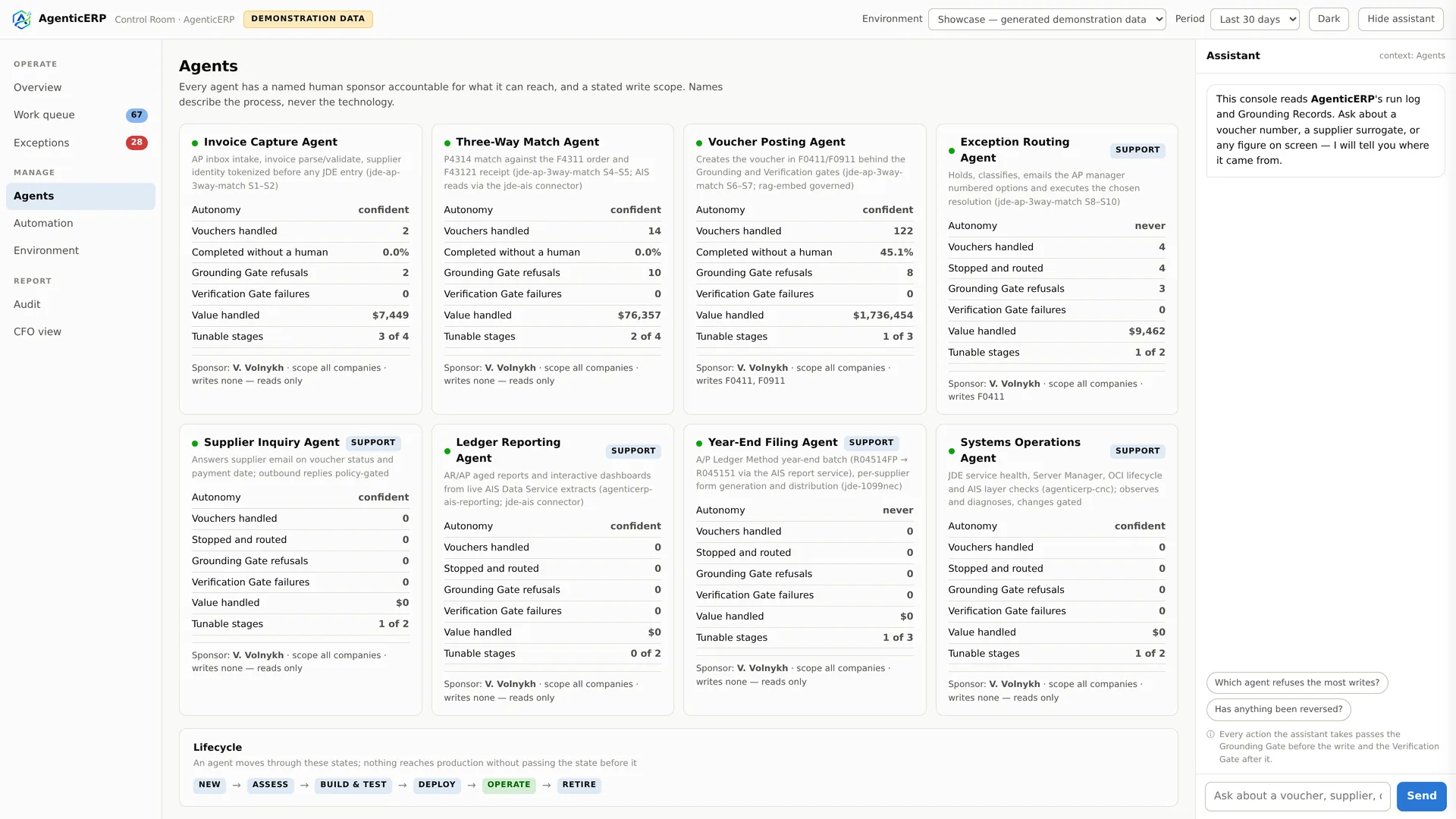
This is exactly what a per-Agent subscription buys: one Agent owns a JDE module, and its sub-agents run the module's workflows — added one at a time, as you're ready.

DEDICATED AGENT

Finance

SUB-AGENTS
  • Manual & recurring journal entries
  • Intercompany balancing & elimination
  • Period-end closure
  • Fixed assets management
DEDICATED AGENT

Accounts Payable

SUB-AGENTS
  • Invoice processing & 3-way match
  • Supplier payment runs
  • Statement reconciliation
  • 1099 / year-end filing
DEDICATED AGENT

Accounts Receivable

SUB-AGENTS
  • Cash application
  • Collections & dunning
  • Customer credit management
  • Revenue recognition
DEDICATED AGENT

Procurement

SUB-AGENTS
  • Purchase order creation
  • Receiving & 3-way match
  • Supplier management
  • Contract compliance
DEDICATED AGENT

Sales Order Mgmt

SUB-AGENTS
  • Order entry & pricing
  • Shipment confirmation
  • Customer returns (RMA)
  • Commission calculation

+ Additional module agents: Inventory · Integration / EDI · HR & Payroll · Manufacturing · Project Costing — one Agent, multiple workflows. See per-Agent pricing.

your perimeter

Your ERP. Your data. Your perimeter.

The first question every Controller and IT Director asks — answered directly. Agents work inside the access you grant, and everything they do is provable.

Your data never leaves your perimeter.
And what does cross isn't readable as your data.

Managed Cloud or Your Perimeter — the security boundary is the same. Your JDE credentials, your F-tables, your pricing, your supplier terms, and your customer records stay inside it. The dedicated agent environment is provisioned single-tenant as an extension of your boundary, under your access controls, revocable at any time.

The only thing that ever crosses is a stateless, TLS-encrypted reasoning call — and before it crosses, it passes through a proprietary encryption layer built into every agent run. Supplier identities, tax IDs, bank details, and other regulated values are encrypted before any request leaves your environment — on every channel the agent works with: records, documents, e-mail, even what it reads on screen. Decryption happens in exactly one place — inside your perimeter, with keys that never leave it — so nobody outside can reconstruct your data: not the model, not the model provider, not us. Zero retention, never used to train any model, and every run writes an audit log proving the layer operated.

Sending your ERP data to a shared cloud is a non-starter. So we don't. Sending it anywhere in readable form is a non-starter too. So we don't do that either.

Managed CloudSingle-tenant VM joined to your security boundary — nothing shared, nothing pooled.
Your PerimeterThe agent runs inside your VPC or data center. It is your infrastructure.
Either wayNo bulk data exports. No credentials off-site. No readable regulated values in any model call. No training on your data. Ever.
YOUR NETWORK PERIMETER JD Edwards E1 E1 web client · AIS REST F0411 · F43121 · UBE · BSFN F-tables never leave ✓ AI Agent Dedicated, isolated VM per client Skills: AP · 1099 · recon · close Credentials vault inside ✓ Scoped, revocable user access E1 screens AIS REST 👤 Your approver Decides every exception human-in-the-loop 📊 Audit run report PDF + XLSX · every action tied to JDE keys + approver every run exceptions · options Claude Anthropic enterprise API Stateless reasoning — no storage No training on your data ✓ Encrypted values only ✓ 🔐 encrypt decrypt key inside ✓ Reasoning only · enterprise terms YOUR MICROSOFT 365 TENANT Microsoft 365 Teams — approvals & alerts Outlook — email intake SharePoint — documents notify · intake · documents Inside: your ERP, your credentials, your approvals, your audit trail. ✕ JDE credentials never cross ✕ No bulk data exports ✕ Nothing used for model training 8 nodes · 9 wires · 0 readable values leave

The agent lives next to your ERP, not between you and it. Only reasoning crosses the perimeter — encrypted on the way out, decrypted on the way back in, with keys that never leave your boundary — under enterprise terms that exclude training on your data.

🏰

A dedicated, isolated environment per client

Each client runs on its own isolated, dedicated VM under enterprise licensing. Nothing is shared between clients — isolation is the architecture, not an option.

🔑

Your credentials stay in your environment

Agents sign in to JD Edwards the way a user does, within the roles and access you grant — scoped, monitored, and revocable like any other account. We never ask you to hand credentials outside your environment.

🔐

Encrypted before it ever leaves

Every agent run passes outbound data through a proprietary, keyed encryption layer: supplier identities, tax IDs, and bank details are encrypted before any call crosses your perimeter and decrypted only inside it — the keys never leave. Nobody outside your boundary can read your business data, and each run's audit log proves the layer operated.

🚫

Your data is not used to train models

Agent instances run under enterprise AI agreements: your transactions, pricing, supplier terms, and documents are not used to train any model.

🧩

Nothing installed inside your ERP

Zero JDE customization — no custom objects, no ESUs, no middleware. Agents use the standard E1 web client and the AIS REST layer Oracle already ships, so your upgrade path and your CNC architecture stay untouched.

🛡️

Humans own every financial decision

Exceptions and judgment calls are escalated to your team with concrete options; the agent executes only what a person chooses. It never guesses with your money.

📜

Audit-ready, every run

Every action lands in standard JDE tables as standard documents, and every run closes with a report tying each step to JDE document keys and the person who authorized it. Built for your auditors, not retrofitted for them.

Security review for your team? Request the security brief.

how we engage

Start with one workflow. Prove it. Then scale.

AgenticERP is a managed service, not a software install. You provide the JDE environment, access, and the process that hurts most; we provide the agent, the skills, the hosting, and the operation.

1

Pilot — one workflow, fixed terms

We pick one high-volume process — AP voucher match, a reconciliation, a close task — and agree the scope, a fixed fee, and measurable success criteria before anything starts. 15–25 days, not quarters.

2

Prove — measured in your environment

The agent runs on your real volumes, in your JDE, against your tolerances. Every run produces an audit report, and results are scored against the criteria we agreed — our fee is tied to hitting them.

3

Scale — a managed agent workforce

Convert to a managed service and add workflows one at a time: AP to reconciliation to period close to reporting. We host, operate, and monitor; your team approves and supervises.

No platform to learn. No project team to staff. No middleware to maintain. See pricing or run the ROI numbers first.

pricing

Priced against the labor it replaces — not the software it isn't

Every engagement starts with a fixed-fee pilot so you see results in your own JDE before committing to anything. Then choose where your agents live.

Automation Pilot

Prove it on one workflow — AP match, a reconciliation, or year-end
$19,500 fixed
15–25 days · one workflow · no further commitment
  • Success criteria agreed in writing before we start
  • Second half of the fee contingent on hitting them
  • Runs on your real volumes, your tolerances, your JDE
  • Audit run report for every batch
  • Pilot fee credited if you continue to a plan
Scope your pilot

Your Perimeter

Agents run on a VM inside your network or private cloud — for regulated shops
$3,500 / mo per Agent
from · annual term · your infrastructure
  • Same per-Agent model — one Agent, multiple workflows — inside your VPC or data center
  • Nothing but encrypted reasoning traffic crosses your perimeter
  • We operate remotely, or train your team to run it
  • Security-review support for your IT and auditors
  • Compatible with your IAM, SIEM, and CNC controls
Talk to us

Every plan: zero JDE customization, audit-ready run reports, humans owning every financial decision — and your data never leaving your perimeter, in either architecture. Not sure of the payback? Run your own numbers first.

roi calculator

JD Edwards AI Agent ROI Calculator

Put your own numbers on agentic automation. Set your labor rate, implementation cost, and projection horizon, pick the workflows you'd hand to an agent, and see labor savings, payback period, and a multi-year projection — live, with an exportable summary.

Interactive model — tuned to JD Edwards workflows like AP voucher match, reconciliation, period close, and year-end processing.

articles

JD Edwards automation, explained

Practitioner guides on what agents can run in E1 — written for the people who run the ERP, not the hype cycle. New deep-dives publish regularly.

faq

The questions every JDE shop asks first.

Can AI agents really operate JD Edwards EnterpriseOne end to end?

Yes. AgenticERP agents operate E1 the way power users do — through the standard web client for screen-bound flows and the AIS REST layer where an API path exists. If a person can do it in JDE — any application, batch job, or orchestration — an agent can run it, plus the steps around the ERP: email intake, approvals, reconciliation, and reporting.

Will this modify or customize our ERP?

No. Zero JDE customization — no custom objects, no ESUs, no middleware. Agents use the standard E1 web client and the AIS layer Oracle already ships, within the access you grant. Your upgrade path and CNC architecture stay untouched.

Does our data leave our perimeter?

No — regardless of the architecture you choose. Your JDE credentials, F-table data, and documents stay inside your security boundary in both deployment models. The only thing that crosses is a stateless, TLS-encrypted reasoning call under enterprise terms: zero retention, never used to train any model, no bulk data exports. And the call itself never carries readable business data — regulated values are encrypted before they leave and decrypted only inside your environment.

How is this different from RPA?

RPA replays coordinates and breaks on the first unexpected popup or tools release. Agents read the screen, understand the business process, and handle edge cases — escalating to a human only when judgment is required. And unlike RPA, every financial decision is gated: exceptions are held in JDE and resolved only on a human's instruction.

How is this different from AI platform toolkits for JDE?

Toolkits give your team something to build with — they require orchestrations or APIs to exist first, and a builder to maintain what gets made. AgenticERP is a managed service: we deliver the running workflow itself, on your screens, from day one. If you want orchestrations, our Orchestration Developer Agent builds them in minutes on request.

What does it cost to start?

A fixed-fee Automation Pilot: one workflow, 15–25 days, success criteria agreed in writing, with the second half of the fee contingent on hitting them. From there, plans are priced per Agent — one Agent runs multiple workflows in its module. Run your own numbers in the ROI Calculator first.

why agenticerp

Built by someone who actually runs JD Edwards.

The AI vendors don't understand JDE. The RPA vendors don't understand business processes. AgenticERP was built by a JDE Solutions Architect who knows P4314 from P0411 — for the people who run E1.

— 01

End to end, beyond the ERP.

Agents run the whole process — email intake, the JDE transaction, reconciliation, reporting, notifications. Not keystrokes. The work.

— 02

Dual access paths, zero customization.

The standard E1 web client for screen-bound flows, AIS REST where an API path exists. No custom objects, no ESUs, no middleware — nothing for your CNC team to maintain.

— 03

Audit-ready, human-in-the-loop.

Financial decisions are never guessed. Exceptions go to your people with numbered options, and every run report ties each action to JDE document keys and an approver.

— 04

A managed service, not a platform to babysit.

You provide the JDE environment and the process that hurts most; we provide the agent, the skills, the hosting, and the operation. Your team approves and supervises.

Val Volnykh — Founder of AgenticERP

Val Volnykh

Founder & CEO · Oracle JD Edwards AI Solutions Architect

Decided the people who run E1 deserve agents that work the way their best analysts do: end to end, with judgment escalated to humans and every action provable.

get in touch

Tell us about your JDE estate.

We'll set up a 30-minute working session: an agent running AP, year-end, or an integration on real JDE screens — your environment, your workflow, a clear next step. No sales theatre.

I'm interested in

No spam. Just one human reading these. We reply within one business day.

Please add your name, a valid work email, company, and a message.